
From MIT Lecture Halls to the Kruonis Pumped-Storage Plant: Kat Chang’s Perspective on the Future of Energy
For many young people, energy still sounds like a distant industry: technical, complex, and reserved for engineers. But that perception is changing rapidly.
At the Massachusetts Institute of Technology (MIT), one of the world’s leading centres of science and innovation, researcher Kat Chang sees energy through a much broader lens. For her, it is a field where technology, economics, policy, sustainability, and global security increasingly intersect. More importantly, it is a space where curiosity can become real-world impact.
Her perspective comes at a time when countries around the world are rethinking how they generate, manage, and consume energy. Decarbonization, electrification, digitalization, and energy security are pushing governments, businesses, and researchers to innovate faster than ever before. In this context, the next generation of talent may have a more important role to play than many realize.
“Everyone Is Working on Something That Matters”
When asked what stands out most about studying and conducting research at MIT, Chang does not begin with rankings or prestige. Instead, she talks about the atmosphere.
“The energy around the university is indescribable. You just feel like everyone is brimming with potential. More importantly, it feels like folks are actually working on things they are genuinely interested in, which just happens to be important to the world as well. That makes the atmosphere exceptionally authentic and inspiring.”
MIT is consistently recognized among the world's leading universities, known not only for academic excellence but also for its ability to transform ideas into practical solutions. Students and researchers are encouraged to think beyond theory, considering early on how their work could create value for society, solve real-world challenges, or serve as the foundation for future innovations.
According to Chang, this is what makes the MIT experience unique.
Innovation is not treated as an abstract concept. It is embedded in the culture. Students are encouraged to explore ambitious ideas while also thinking about implementation, collaboration, and long-term impact. In other words, innovation is not just about having good ideas. It is about creating the conditions to act on them.
A Growing Link Between MIT and Lithuania
That mindset is becoming increasingly relevant for Lithuania.
A significant milestone was reached in 2025, when a cooperation agreement between the Lithuanian consortium and MIT further expanded opportunities for knowledge exchange, internships, and joint projects.
This summer, Lithuania’s innovation ecosystem is being strengthened directly by eight MIT students participating in the programme. They are contributing to projects across six consortium partner organizations, including Lietuvos geležinkeliai (LTG), Euromonitor International, the Lithuanian Energy Institute (LEI), VILNIUS TECH, Vilnius Academy of Arts (VDA), and Kaunas University of Technology (KTU).
Kat Chang is among them, bringing MIT’s collaborative spirit and research-driven approach to Lithuania’s growing energy and technology landscape.
Programs like MISTI serve as an important model, demonstrating that engagement with world-class innovation need not depend solely on geography. The MISTI framework highlights how international collaboration can transcend geographic boundaries in the world of innovation.
Partnerships between Lithuania and globally recognized institutions can create pathways not only to new knowledge, but also to new ways of thinking about the country’s future in science, technology, and energy.
The Energy System Is Becoming More Complex and More Flexible
If the last decade was defined by the expansion of renewable energy, the next may be defined by a more challenging question: how to build an energy system that is cleaner, more electrified, and still reliable.
Chang believes the answer will increasingly lie in hybrid energy systems and more active demand management.
“Hybrid systems and active demand management will become the norm. As countries realize what lessening baseload capacity means for energy management, hybrid configurations, such as renewables combined with energy storage, will be the baseline expectation. At the same time, demand-side management will grow increasingly crucial for maintaining grid stability.”
Her observations reflect a broader shift taking place across the global energy sector. Future energy systems will require more than additional generation capacity. They will depend on better coordination between electricity production, storage, and consumption, often in real time.
This transformation extends far beyond traditional engineering disciplines. Data analytics, artificial intelligence, cybersecurity, economics, regulation, and public policy are becoming increasingly important in shaping how energy systems operate.
For Lithuania, which has placed energy security at the centre of its long-term strategic priorities, these developments are particularly relevant. Chang notes that the country stands out for its clear focus on strengthening resilience while navigating geopolitical and market challenges.
A Summer in Lithuania and a Long-Term Energy Bet
Chang first arrived in Lithuania during the summer and quickly found herself drawn to both the landscape and the people.
“I was amazed by how green everything is during the summer. I love nature and staying active, so the natural shade and tree cover were a wonderful revelation. I even ended up cycling a lot throughout the summer. The community has been incredible.”
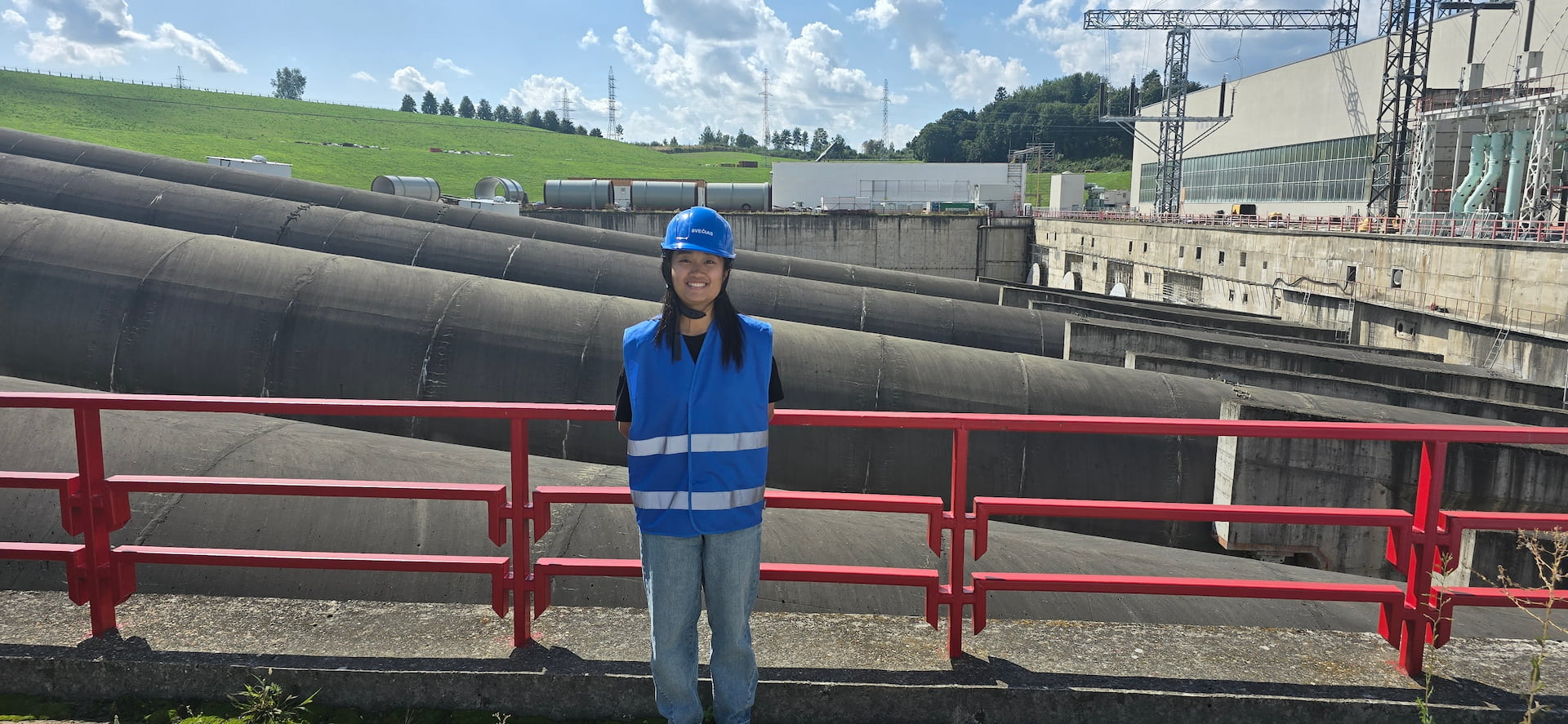
During her time in Lithuania, Chang also had the chance to experience the country’s critical energy infrastructure firsthand including a visit to the Kruonis Pumped Storage Hydroelectric Plant (Kruonis PSHP), operated by Ignitis Gamyba. Impressed by the facility's scale and strategic function, she saw it as a compelling real-world example of how energy storage, grid flexibility, and large-scale infrastructure come together to secure grid stability.
Yet when asked to imagine what she would prioritise if resources were unlimited, her thoughts turn directly to the future of electricity generation.
As data centres expand and digital infrastructure drives growing electricity demand, Chang sees one technology as playing an important role in the near and medium term: Small Modular Reactors (SMRs).
“SMRs offer a practical pathway to increasing clean generation capacity in the near and medium term. Developing the policy and regulatory framework around the technology is just as important as the reactors themselves.”
At a time when much of the global energy conversation focuses on renewables, storage technologies, and the long-term promise of fusion, Chang sees SMRs as one of the more realistic opportunities to increase reliable, low-carbon electricity generation in the coming decades.
Her answer also highlights an important reality: technology alone is not enough. The success of emerging energy solutions depends not only on engineering breakthroughs but also on effective regulation, licensing frameworks, public acceptance, and international cooperation.
For students considering careers in energy, this serves as an important reminder that many of the sector’s biggest challenges will be solved not only by engineers but also by economists, policymakers, lawyers, communications professionals, and technology specialists.
More Than an Industry for Engineers
For young people interested in pursuing a career in energy, Chang’s advice is straightforward.
“For energy, know your fundamentals. Electrons will remain electrons. Once you have a strong grasp of market economics, you can speak the language fluently and follow where the industry leads.”
Today, energy is no longer a niche industry reserved for traditional engineering professions. As energy systems become increasingly interconnected and sophisticated, the sector needs talent from a wide range of disciplines.
Whether someone is passionate about data science, economics, environmental policy, cybersecurity, law, strategic management, or user experience design, there is a growing opportunity to contribute to the energy transition.
This is particularly encouraging for students who want to work on climate action, sustainability, technological innovation, or national resilience but may not see themselves pursuing a conventional engineering degree. The energy transition requires diverse perspectives, skills, and expertise.
For those dreaming of studying at institutions such as MIT, Chang offers another piece of advice.
“Explore your interests and figure out why you want to study at such a university. Beyond an invaluable education, the greatest asset of places like MIT is meeting peers you can learn from, grow with, and be inspired by. The clearer you are on why you want to be there, the more you will get out of the experience.”
Why Energy Now Feels Different
Chang’s story reflects a broader change in how energy is understood today.
It is no longer simply a sector that keeps lights on and factories running. Increasingly, energy sits at the centre of economic competitiveness, technological advancement, climate action, and national security. Few industries offer such a direct connection between local decisions and global impact.
Perhaps the most important lesson from Chang’s experience is that innovation rarely begins with expertise alone. It often starts with curiosity.
Whether that curiosity leads to engineering, economics, policy, data science, entrepreneurship, or another field entirely, the future of energy will depend on people who are willing to ask difficult questions and help create new solutions.
For Lithuania’s young generation, the opportunity to contribute has never been greater. As international partnerships continue to grow and the country's energy transformation accelerates, new pathways are opening for students from a wide range of backgrounds.
For anyone seeking a career that combines innovation, real-world impact, and the chance to contribute to some of society’s most important challenges, energy may be one of the most exciting places to build it.